You used to know what good looked like. It had edges. It asked something of you. Maybe a painting that stopped you cold long enough for your coffee to go tepid. A photograph that tightened your chest for reasons you couldn’t explain over brunch. Now? Good is a smoothie bowl shot from directly overhead. A sunset with the saturation slider jammed so far right the sky resembles a fresh wound. Instagram didn’t just change how we see. It rewired what we want to see—and pulled it off so quietly we mistook the whole shift for progress.

The platform began, at least in theory, as a home for the imperfect snapshot. Grainy, off-kilter, a little drunk. Remember the early filters? They faked analogue warmth, light leaks, the happy screw-ups of film. The irony, naturally, is that we reached for digital tools to mimic physical error. The aesthetic was nostalgia for a present we were already misplacing. Then the algorithmic feed arrived, and the visual language hardened like week-old bread. The feed became a portfolio, not a diary. Every image had to perform. And performance, as any critic can tell you, flattens texture into applause.
The Rise of the Scroll-Stopping Cliché
Walk through any gallery district and you’ll spot the influence before you clock the art. Young painters compose for the phone screen. Sculptors weigh 1080×1350 proportions. I spoke with a gallerist in Berlin last autumn who admitted, off the record, that she now assesses submissions first on her phone, because “if it doesn’t work there, it doesn’t work anywhere.” That’s not a small adjustment. It’s a ground-up redefinition of scale and attention. A canvas is not a feed. A print is not a story. Yet we’ve collapsed these distinctions without so much as a show of hands.
Consider the tyranny of the “saveable” image. Instagram’s internal metrics reward bookmarking. Which means a picture gets judged not by whether it moves you, but by whether it’s useful. A recipe. A workout routine. A colour palette for your sitting room. Utility has become the primary aesthetic virtue. We no longer look at images to be unsettled. We look to extract. To stockpile. To pin. The language has followed along obediently. Comment sections overflow with “need this” and “adding to my list.” Desire got swapped for inventory management.

This shift has been especially cruel to photography. The medium was already fighting a century-long battle to be taken seriously as art. Now a photograph’s worth gets measured in engagement, not intention. A photojournalist I know—someone who has documented conflict zones for two decades—told me her most “successful” image, by Instagram’s arithmetic, was a picture of her cat asleep on a radiator. Not the grieving mother in Mosul. Not the child soldier in Kivu. The cat. The algorithm doesn’t care about witness. It cares about warmth, familiarity, and a colour temperature that won’t startle anyone scrolling at 2 a.m.
The Erasure of Ambiguity
Art needs friction. Even the most beautiful things—a Rothko, a Bach partita, a line of Akhmatova—contain a kernel of resistance. They don’t hand themselves over immediately. Instagram, by design, removes friction. The double-tap is the most frictionless gesture in human history. You don’t have to understand. You don’t have to feel. You just have to tap. And the more you tap, the more the machine learns to serve up things you’ll tap again. It’s a closed loop of validation that has nothing to do with aesthetic judgment.
I’ve watched this eat away at critical vocabulary among students. When I ask a seminar group why a particular image is strong, I get answers about “aesthetic,” “vibe,” “mood.” Those aren’t descriptive. They’re emotional weather reports. Push them, and they reach for Instagram-native words: clean, cohesive, curated. A feed is curated. A life is not. But the distinction is collapsing. We now describe flats, wardrobes, even relationships as “curated.” The word implies a selector, an arranger, a consciousness standing outside the thing and pruning it for display. We’ve turned into curators of our own existence, and the collection is forever up for sale.
The Flattening of Taste Hierarchies
You could argue this is democratization. A teenager in Jakarta can develop an eye without ever setting foot in MoMA. And there’s a sliver of truth there. Access has widened. But access to what? The feed presents everything at the same size, the same brightness, the same scroll velocity. A Cindy Sherman untitled film still sits next to a flat lay of autumn boots. A still from a Tarkovsky film scrolls past a sponsored post for teeth whitening strips. The context collapse is absolute. And context, for art, is half the meaning. Strip it away, and you’re left with pure retinal stimulation. Pretty or not pretty. Double-tap or keep scrolling.
This levelling has produced a strange new category: the art-adjacent image. These are photographs that borrow the signifiers of fine art photography—muted palettes, negative space, ambiguous framing—but contain no actual idea. They look like something you’d see in a gallery, but they’re hollow. They’re engineered to signal taste without demanding it. The visual equivalent of a person who pronounces “croissant” correctly but has never set foot in France. I see them everywhere now. In portfolios. In exhibitions. In the pages of magazines that should know better. They’re not bad images. They’re just not about anything. They’re about looking like they’re about something.
The tragedy is that this isn’t a conspiracy. There’s no cabal of engineers in Menlo Park deciding that ambiguity must die. It’s simply the output of a system optimized for time-on-device. The machine doesn’t hate depth. It just doesn’t know what it is. And because we spend hours a day inside that machine, neither do we—not quite, not anymore. We’ve outsourced our taste to a black box that measures success in seconds and saves. We’ve allowed “good” to become whatever keeps the thumb moving.
The Performative Gaze
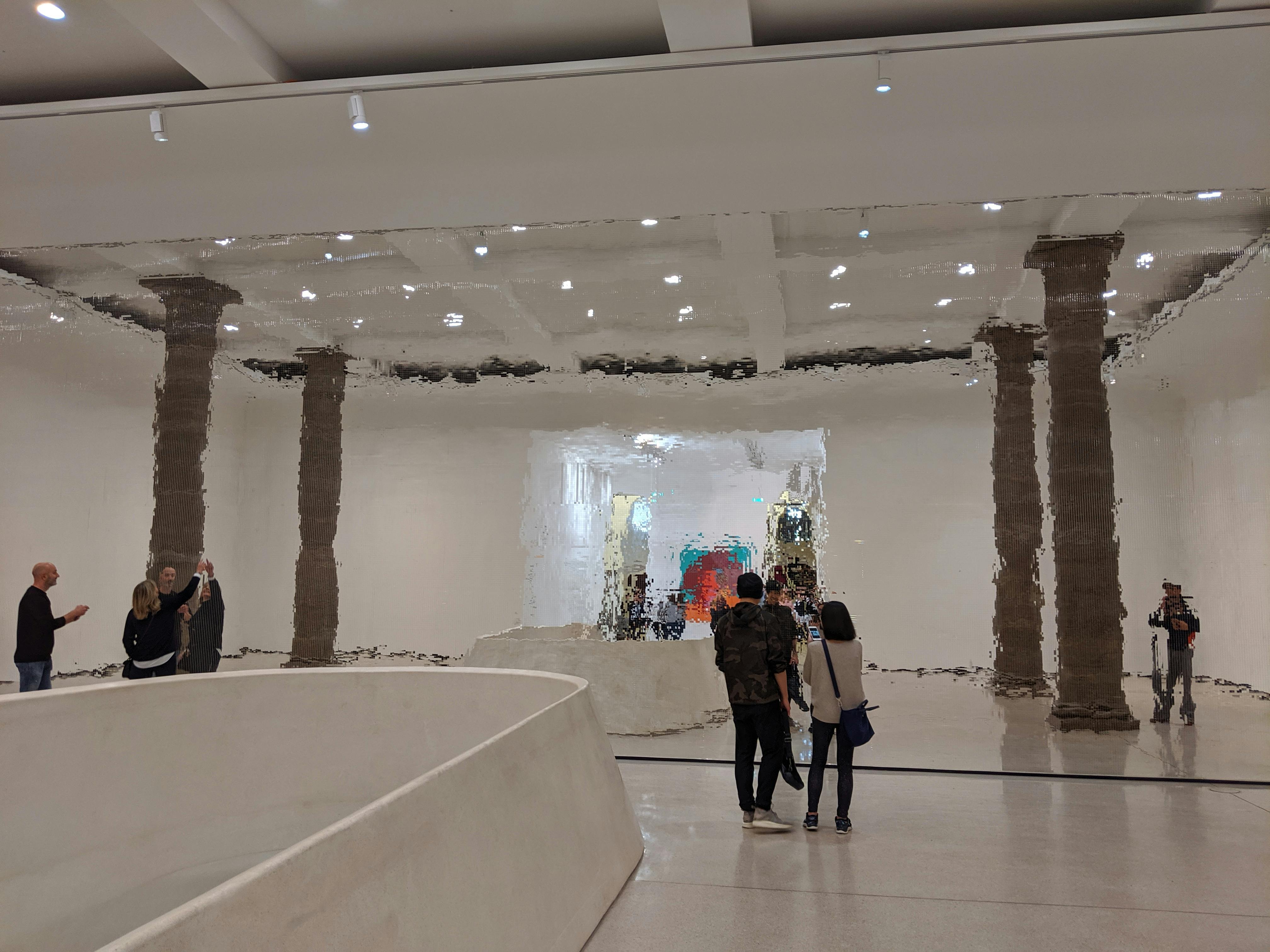
There’s a particular loneliness in watching people photograph art in museums these days. They don’t look at the painting. They look at their phone’s screen, which is looking at the painting. They’re composing the shot, checking the light, ensuring the frame is clean. The experience is mediated through the act of documentation. The proof of having been there outweighs the being there. I once stood behind a woman at the Louvre who spent four minutes photographing the Mona Lisa from different angles, then walked away without once lifting her eyes to the actual canvas. She has the image. She doesn’t have the memory. She has content.
This is the final victory of Instagram’s definition of good. It doesn’t have to be experienced. It just has to be captured. The image is not a window into a moment. It’s a brick in the wall of a personal brand. And if that sounds cynical, it’s because the situation is cynical. We’ve trained ourselves to see everything as potential content, which means we see nothing as fully real. The sunset is a background. The meal is a prop. The art is a status marker. We are living at one remove from our own lives, and the remove has become the product.
Can We Recover the Gaze?
I’m not advocating for a Luddite retreat. The platform isn’t going anywhere. But we can name what’s been lost, which is the first step toward clawing it back. Next time you see an image that stops you, ask why. Not whether it’s saveable. Not whether it fits your grid. But what it’s doing. What it’s asking of you. Whether it leaves a splinter. The images that matter don’t soothe. They unsettle. They refuse to be useful. They demand you meet them on their terms, not yours. That’s what good used to mean. It still can, if we’re willing to let it.
Frequently Asked Questions
Has Instagram completely ruined visual taste?
Not completely. The platform has widened access to visual culture, and some creators use it to share genuinely challenging work. The problem is structural: the algorithm rewards ease, not difficulty. The result is a flattening, not a total wipeout. Taste still exists, but it’s being shaped by invisible metrics more than by conscious judgment.
Can an image be popular on Instagram and still be good art?
Of course. Popularity and quality aren’t natural enemies. But when an image’s value is measured solely by its performance—likes, saves, shares—the definition of quality drifts toward whatever generates those numbers. The danger isn’t that good art can’t be popular. It’s that we stop asking whether popularity is the right yardstick at all.
How can I train myself to see beyond the Instagram aesthetic?
Spend time with physical art objects. Go to galleries, but leave your phone in your pocket. Look at books of photography printed at a scale that resists the scroll. And when you’re online, follow accounts that confuse you, not just ones that confirm your taste. Confusion is a sign you’re encountering something that hasn’t been optimized for you. That’s where real seeing begins.